
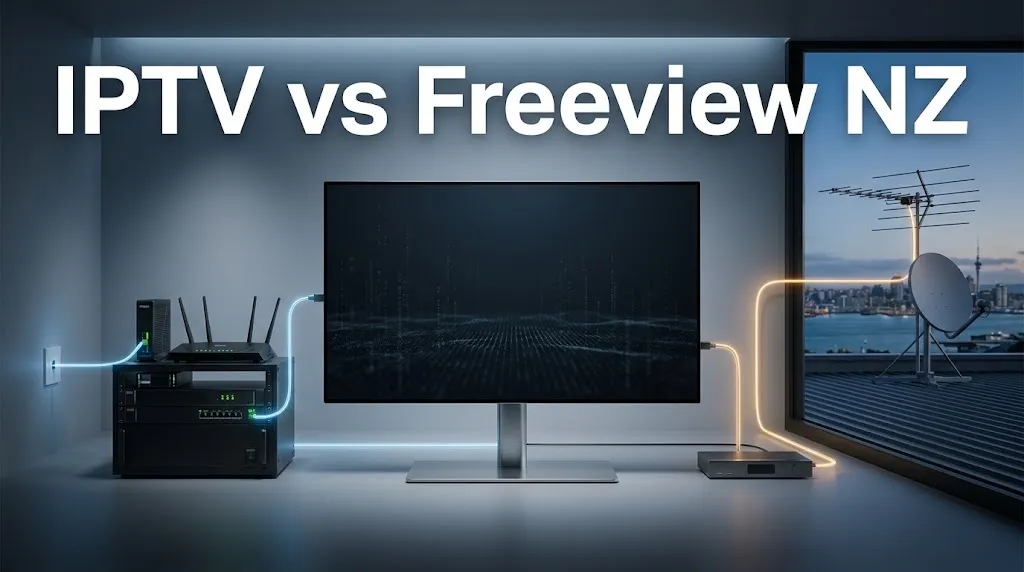
Most people who set out to compare IPTV vs Freeview NZ start from an assumption that quietly breaks the comparison before it begins: that the two are rival technologies, one old and one new. They aren’t opposites. Freeview is New Zealand’s free-to-air television platform, and it already reaches some viewers over their broadband connection.
IPTV, meanwhile, isn’t a service at all — it describes how video travels. If you want the wider picture of how streaming fits together here, the Kiwi IPTV guide covers the whole landscape; this article stays on Freeview, and what it’s actually being compared against.
Quick Answer
Freeview is New Zealand’s free-to-air television platform, reaching homes by UHF aerial, satellite dish, or its own streaming app. IPTV means television delivered over an internet connection — a delivery method, not a single service. So the real comparison is between free, licensed local broadcasting and a paid subscription with a much wider content scope.
It pairs naturally with catch-up TV in NZ if what you actually want is to watch programmes after they’ve aired.
What Is Freeview in New Zealand?
Freeview is the country’s free-to-air television platform, run as a joint venture by the major free-to-air broadcasters rather than by a single company. There is no subscription and no monthly bill. What you pay for is the equipment that receives it, once, and nothing after that.
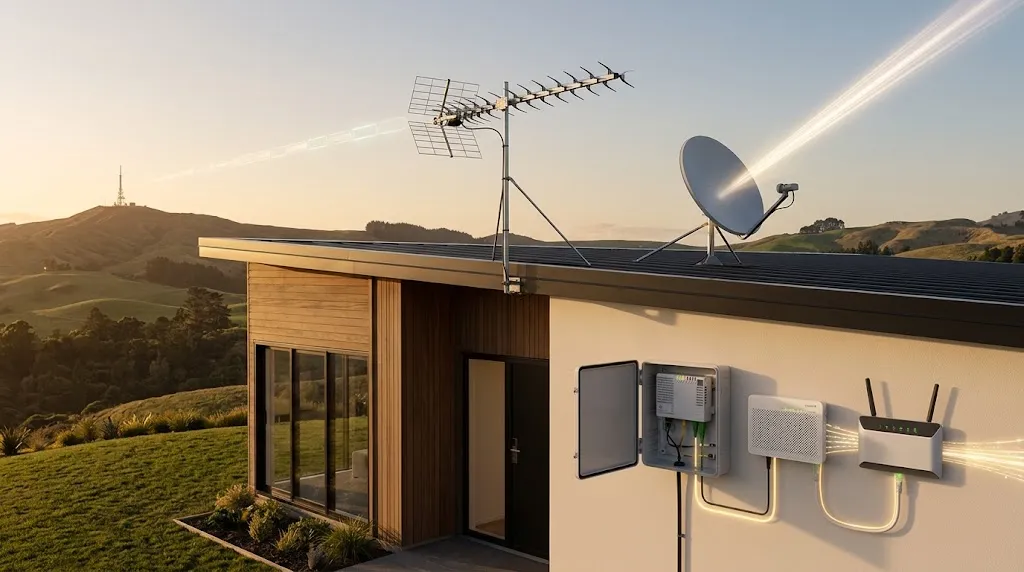
It currently reaches viewers three ways, and which one you have determines almost everything about how it behaves.
Freeview via UHF Aerial
This is terrestrial broadcasting — a signal sent from transmission towers to a rooftop aerial. Freeview says UHF coverage is available to about 87% of New Zealand homes. Because the signal travels through the air from a tower, it can’t cross mountain ranges or large stretches of water, so coverage varies by address rather than by town. Two neighbours on the same street can get different results.
Freeview via Satellite Dish
Satellite provides nationwide coverage for homes with a suitable dish, including areas outside UHF reception. Because the signal comes from above rather than from a tower, terrain stops mattering — which is what makes it the standard route for rural households. Freeview moved its transmissions to a replacement satellite in 2025 when the previous one retired, and advised that older satellite boxes be replaced to keep working.
Freeview via the Streaming TV App
The third route is the Freeview Streaming TV app, which delivers live channels over your broadband connection on compatible smart TVs and devices. This is where the usual framing of this comparison starts to wobble: the app already delivers live television over an internet connection, which is why the boundary between “Freeview” and “IP-based TV” is not as clean as it first appears.
Key takeaway: Freeview is one platform with three current delivery routes — aerial, satellite, and an app that streams over broadband.
Freeview NextGen: Free-to-Air TV Is Moving to Broadband Too
The aerial and the satellite dish are not going anywhere. What’s coming is an IP-based extension of Freeview’s existing architecture, and it’s a significant one.
In May 2026, Freeview announced Freeview NextGen, a broadband-delivered free-to-air service expected to launch in the third quarter of 2026 with television manufacturers TCL and Hisense as launch partners.
What DVB-I Actually Means
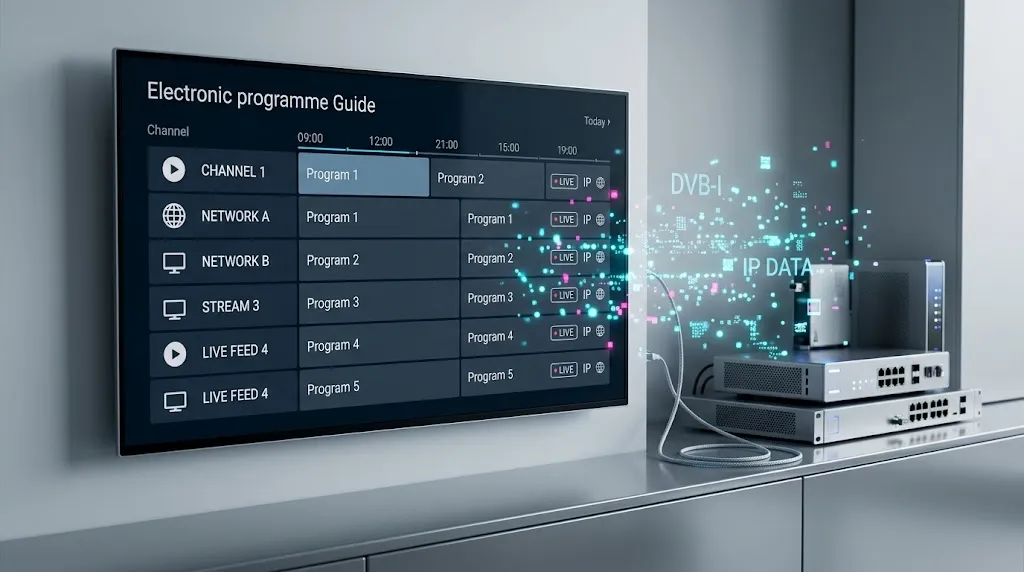
Freeview NextGen is built on DVB-I, an open standard for finding and describing television services over the internet. In plain terms: instead of opening an app to reach live channels, the channels appear in the television’s own guide during normal setup, where a viewer would expect broadcast channels to sit. The delivery is internet-based; the experience stays linear and familiar.
What Was Announced
Freeview says NextGen will deliver live channels over broadband or Wi-Fi without a dedicated app, a satellite dish, or an aerial connection. For households that have both an antenna and broadband, the service is designed to combine broadcast and IP signals into a single programme guide and strip out duplicate channels automatically.
Expected Availability
As of September 2026, Freeview NextGen remains a forthcoming service rather than one generally available to consumers. Availability at launch is planned for TCL and Hisense sets only, with Freeview expecting broader support as more manufacturers adopt the standard. Treat the timing as planned rather than settled, and check the Freeview website for current status before making a purchase decision around it.
Key takeaway: Freeview is expanding its free-to-air offering with an IP-based delivery option — adding a route, not replacing the aerial or dish.
IPTV vs Freeview NZ: What Are You Actually Comparing?
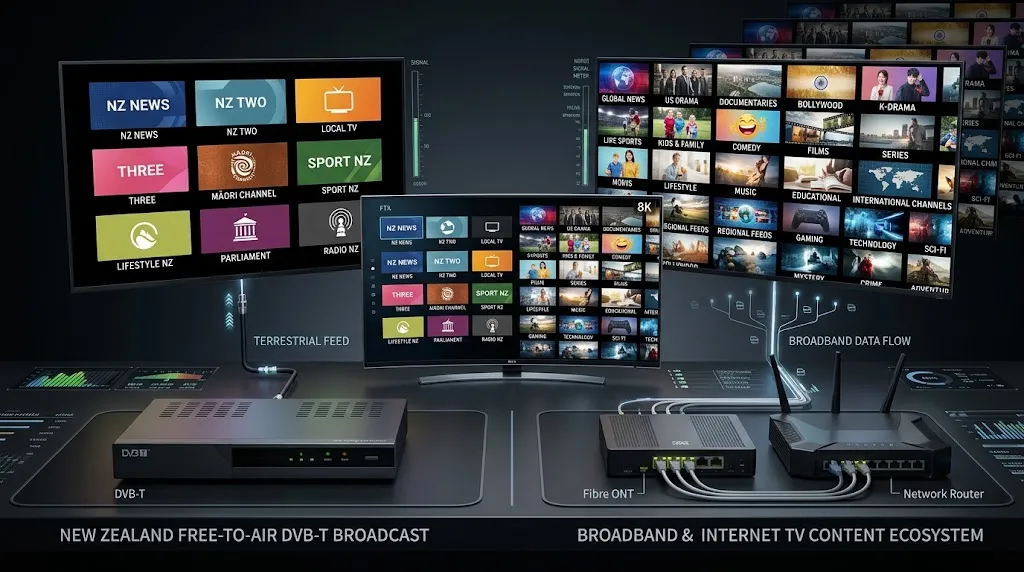
You are comparing a funding and licensing model, not a technology. Freeview is free, licensed New Zealand broadcasting that uses several delivery routes, internet delivery among them. A third-party IPTV service is a paid subscription delivered over the internet. The delivery overlaps; what differs is who supplies the content.
Two things are worth keeping separate here. An IPTV player — TiviMate, IPTV Smarters Player, and similar — is software, and supplies no channels at all. An IPTV service is the source those channels come from. Freeview is both at once: the platform and the content, with the broadcasters themselves behind it.
IPTV vs Freeview: Key Differences
| Freeview | Third-party IPTV service | |
|---|---|---|
| Delivery method | Aerial, satellite, streaming app (NextGen planned) | Internet connection required |
| Content scope | New Zealand free-to-air channels | Varies by provider — check before subscribing |
| Internet needed | Only for the app and NextGen routes | Always |
| Hardware | Compatible TV, plus aerial or dish for broadcast routes | Compatible TV, streaming device, or box |
| Coverage | About 87% by aerial; nationwide by satellite with a suitable dish | Wherever the connection holds up |
| Ongoing cost | None | Subscription — verify terms before paying |
| Licensing status | ✅ Official NZ free-to-air platform | Varies by provider — verify before subscribing |
| If something breaks | TV or receiver, aerial or dish, app, or the broadcaster | The provider, and your retail ISP |
That last row decides more in practice than people expect. With Freeview, troubleshooting starts with an identifiable part of the setup — the television or receiver, the aerial or dish, the app, or the relevant broadcaster or transmission provider. Freeview itself does not manage transmission. With an internet-delivered subscription, the fault could sit with the provider, your retail ISP, the local fibre company, or your own home network, and separating those takes real work.
Does Freeview Need the Internet?
Only partly. The aerial and satellite routes are broadcast — they use none of your broadband data and keep working during an internet outage. The Freeview Streaming TV app and the planned NextGen service do need a connection. One household can have both, so the answer varies television by television.
The distinction cuts both ways. A broadcast route is resilient but tied to physical reception at your address. An IP route ignores terrain completely but inherits every problem your connection has. If your household leans on internet delivery for live television, the internet speed guidance for IPTV in NZ is the more relevant read, and rural households on fixed wireless or Starlink should think about latency and weather rather than headline speed.
When Freeview May Be Enough
For a meaningful number of New Zealand households, it genuinely is — and that’s worth saying plainly rather than treating Freeview as a fallback.
It tends to be enough when local news, current affairs and New Zealand-made programmes are most of what gets watched; when nobody in the house follows international or non-English-language content; when the broadband connection is unreliable, metered, or shared with people working from home; when a household wants no recurring subscription at all; and when someone is replacing a television anyway and may find NextGen built into a compatible set without buying anything extra.
There’s a pattern worth naming. People assume that because Freeview is free it must be the lesser option, then pay monthly for a wider service while watching almost entirely what Freeview already carried.
When an External IPTV Service Is a Different Proposition
The honest case for looking beyond Freeview is scope, not quality. Freeview carries New Zealand free-to-air television. It does not attempt to carry international channels, other languages, or the range of on-demand material a household might want. A household with those needs is asking for something Freeview was never built to provide.
If that’s the situation, work through the official and licensed options first — the broadcasters’ own streaming platforms and the subscription services that operate here — and treat anything additional as something to assess rather than assume. How to choose an IPTV service in NZ covers what that assessment involves. If the comparison you actually have in mind is against paid television rather than free-to-air, IPTV vs Sky NZ is the closer fit.
IPTV vs Freeview NZ: Which Makes More Sense for You?
It depends on scope first and your connection second. If what your household watches sits inside New Zealand free-to-air programming, Freeview covers it at no ongoing cost and with better resilience. If you want content beyond that, Freeview cannot supply it, and the question becomes which additional service is appropriate and verifiable.
What it shouldn’t come down to is a belief that Freeview is technically outdated. With NextGen planned, the free-to-air platform is moving toward internet delivery on the same terms as everything else — while keeping the broadcast routes that work when the internet doesn’t.
What to Check Before Choosing
- Your actual UHF reception at your address, not your suburb — Freeview’s address checker answers this directly
- Which Freeview route your television is already using, since many households don’t know
- Whether your TV supports the Freeview Streaming TV app, and whether it’s a brand committed to NextGen
- How stable your connection is at peak evening hours, which matters far more than your plan’s headline speed
- For any paid service: who is behind it, what it is licensed to carry, and what happens if it stops working
Key takeaway: Reception at your specific address, not your region, is the single most useful thing to establish before choosing either route.
The Legal Picture
Freeview is free, licensed New Zealand television, and using it raises no copyright question. For any other service, what matters is the source of the content rather than the software displaying it — the is IPTV legal in NZ guide covers how the Copyright Act 1994 applies.
This article is for educational and comparison purposes only. Verify the licensing status of any streaming service and ensure compliance with New Zealand copyright law before subscribing.
Explore More
Guides: Kiwi IPTV Guide · IPTV vs Sky NZ · Is IPTV Legal in NZ? · How to Choose an IPTV Service NZ
Channels & Content: Catch-Up TV NZ · TVNZ OnDemand vs IPTV NZ
Setup: Internet Speed for IPTV NZ · IPTV on Starlink NZ · Best IPTV App NZ
Bottom Line
The IPTV vs Freeview NZ question resolves differently depending on the household:
If you mostly watch New Zealand television — Freeview covers it free, and a broadcast route keeps working through an internet outage. Paying monthly on top buys scope you may not use.
If you’re rural or your connection is unreliable — satellite Freeview is the resilient option, since it doesn’t touch your broadband at all. Anything internet-delivered inherits whatever your connection does on a bad evening.
If you want content Freeview doesn’t carry — this stops being a comparison, because the two aren’t substitutes. Start with the official and licensed services available here, and assess anything beyond them on who runs it and what it’s licensed to show.
Sources
- Freeview New Zealand — coverage, delivery routes, and satellite update information
- DVB — Freeview NextGen DVB-I announcement, May 2026
- Copyright Act 1994 — legislation.govt.nz