
‘Arabic channels IPTV NZ’ is a search that often starts in frustration. Someone has checked what mainstream New Zealand television offers in Arabic, found nothing, and gone looking for another route. That frustration is well founded, and the answer is more layered than the guides you will find first suggest.
This guide covers why the gap exists, which official routes to check before anything else, and how to judge whether any service — IPTV or otherwise — actually delivers the Arabic content your household watches.
This guide sits in the International IPTV NZ category and is part of the Kiwi IPTV Guide, which covers streaming in New Zealand more generally.
Why Mainstream NZ Television Doesn’t Serve Arabic Households
New Zealand’s MELAA population — Middle Eastern, Latin American and African — was recorded at 92,760 people in the 2023 census, having grown 31.9% since 2018, making it one of the faster-growing groupings in the country. Arabic-speaking households from Lebanon, Egypt, Syria, Iraq, Jordan, Morocco and the Gulf make up a substantial part of that, concentrated in Auckland, with significant communities in Wellington and Canterbury.
Mainstream New Zealand broadcasters carry no Arabic-language channels. That is not an oversight so much as arithmetic: broadcast rights are licensed territory by territory, and a market this size rarely justifies the cost of acquiring them for a commercial broadcaster.
The same gap applies to Hindi, Tamil, Tagalog, Samoan and Tongan. New Zealand’s multicultural communities are consistently underserved by mainstream broadcast relative to their actual size, and Arabic-speaking households are seeking alternatives for that reason rather than any other.
What “Arabic Content” Actually Means
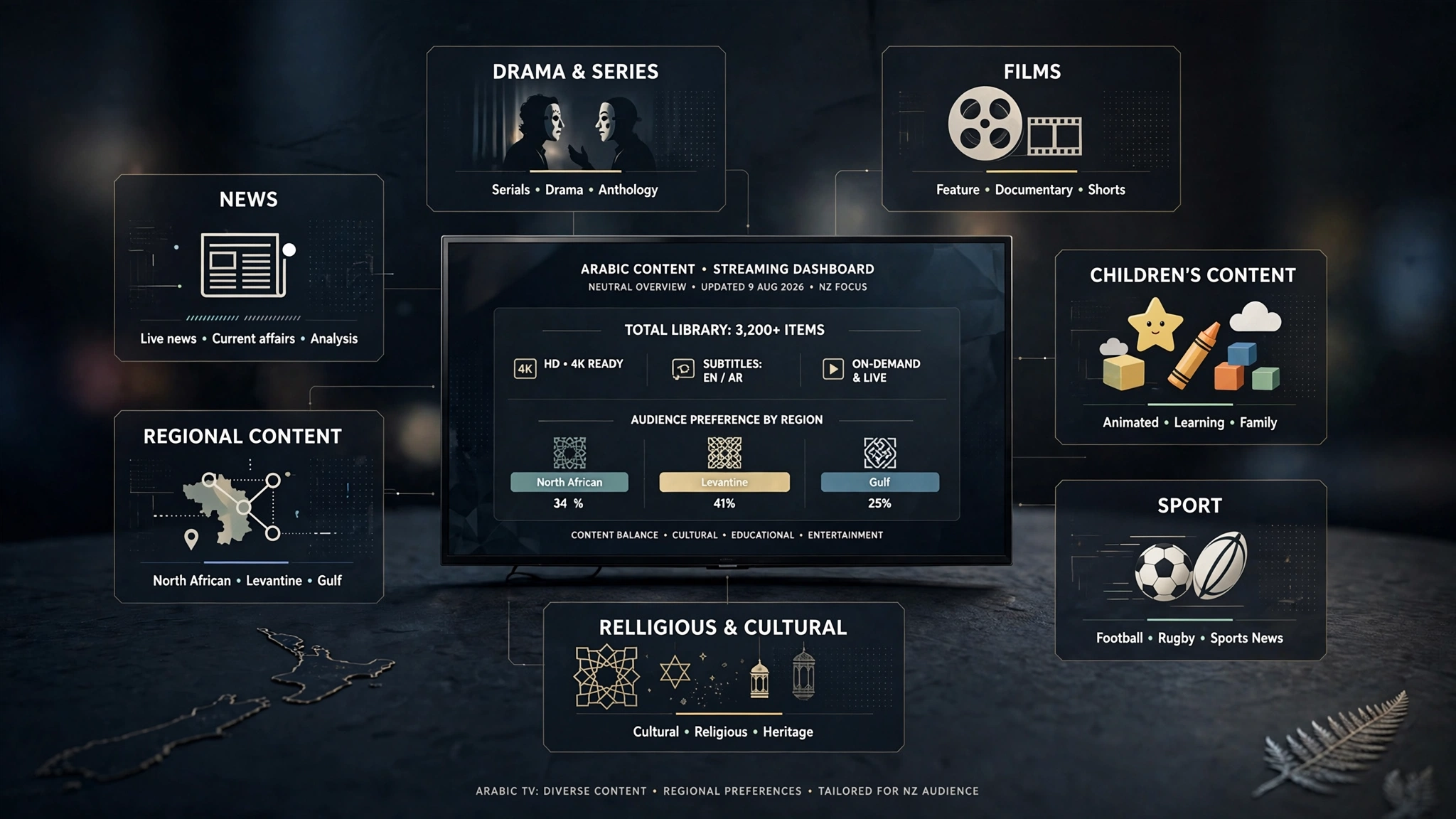
Before evaluating any service, be specific about what you want, as “Arabic channels” covers wildly different things and no single service does all of them well.
News. Pan-Arab news is a distinct category from international news services that happen to broadcast in Arabic. Households following developments in a specific country often want that country’s own coverage rather than regional coverage.
Drama and series. Drama and series are the largest category by viewing hours and the most regionally specific. Egyptian, Levantine, Gulf and Turkish-dubbed dramas have quite separate audiences, and a service strong in one may carry almost nothing of another.
Film. Both classic and contemporary Arabic cinema are again split heavily by country of origin.
Children’s programming. Children’s programming often serves as the single most important category for families raising New Zealand-born children with a connection to Arabic, yet it is frequently the least well served.
Sport. A small number of rights holders with strict territorial licensing dominate Arabic-language sports broadcasting. This area is the category where availability claims deserve the most scrutiny and where a service’s answers matter most.
Religious and cultural programming. A steady category with dedicated audiences, generally more widely available than premium entertainment.
Regional orientation. North African, Levantine and Gulf content are genuinely different markets. A Moroccan household and a Kuwaiti household asking for “Arabic channels” may want very different content.
Please write down which of these categories matter in your home before you look at any service. That list is what you will test against.
Start With the Official Services
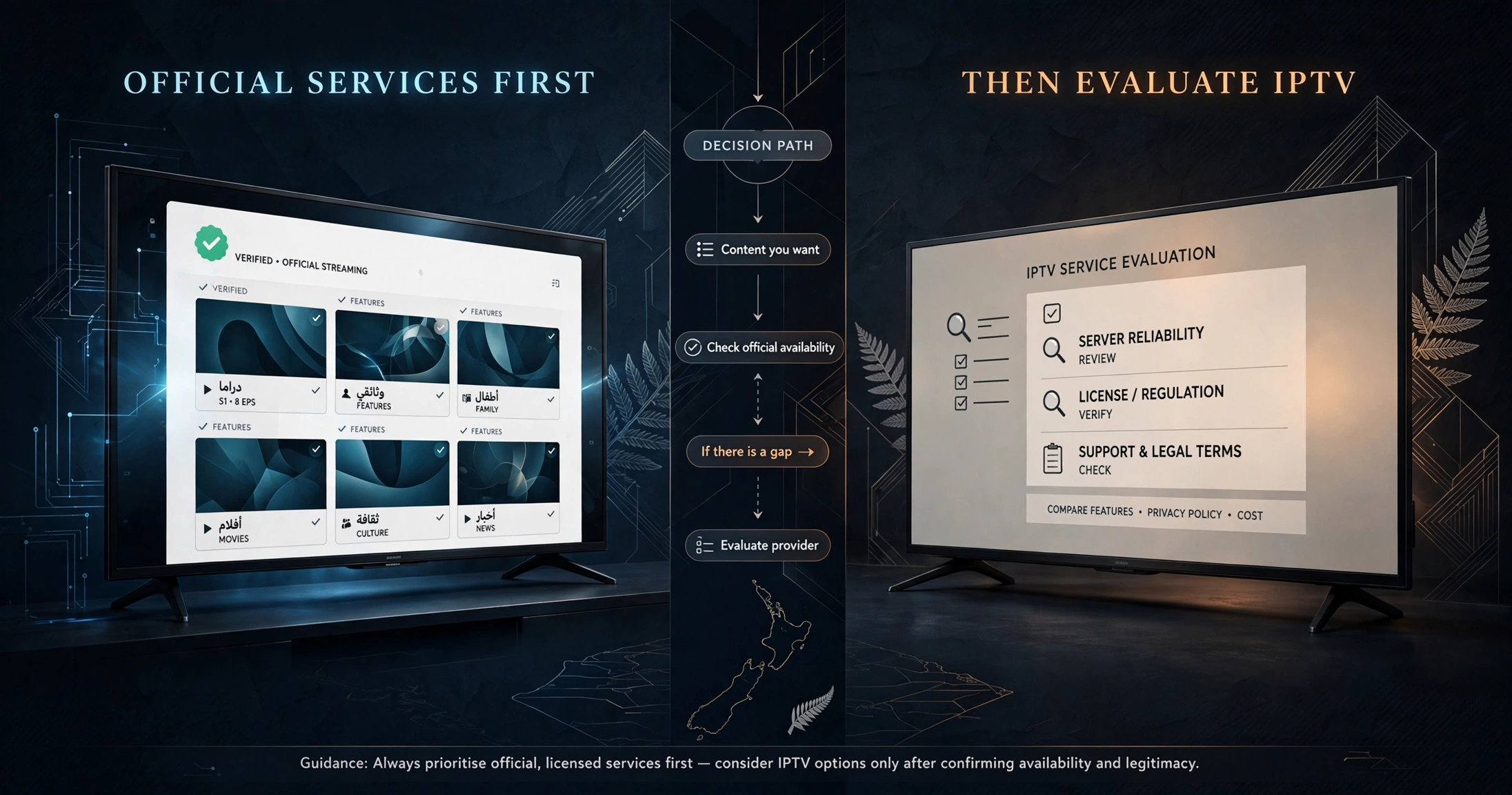
This procedure is the step most guides skip entirely, and it should come first.
Arabic broadcasters and media groups increasingly operate their own official streaming platforms, distributing their content directly rather than only through television. Several of these operate internationally, and some are available in New Zealand. They carry the content their parent networks produce, with clear licensing, working apps and accountable support.
Why check these first: if an official service carries what you actually watch, you have a straightforward, unambiguous answer with none of the questions that follow later in this guide. It is worth ten minutes to find out.
How to check: search for the broadcaster or network whose programming you follow, alongside “streaming” or the platform’s own name, and look for the official site rather than a third-party listing. Check whether New Zealand appears among supported countries and whether the specific programming you want is included in the plan available here rather than only in the Middle East.
Where they fall short: these platforms are usually organised around the catalogue of one network. A household following drama from one network, news from another, and sport from a third will not find it all in one place. That is the genuine gap a broader service fills — and it is a real gap, not a manufactured one.
Some Arabic broadcasters also stream news channels free through their own official websites and video platforms. For news specifically, that is often the simplest answer of all.
Arabic Channels IPTV NZ — How to Check What a Plan Includes
If official platforms do not cover what your household watches, the question becomes how to evaluate a broader service. Not which one to pick, but how to judge any of them.
Ask about your categories, not about channel numbers. Take the list you wrote earlier and ask directly whether the plan includes Levantine drama, or Arabic children’s programming, or whatever it is you actually watch. A channel count answers nothing. A service claiming enormous numbers of channels is telling you about its marketing, not its content.
Ask them to describe the licensing arrangement. A provider operating properly can explain what it is licensed to carry. One that cannot be redirected to features. That redirection is your answer, and it is worth more than any list you could have been given.
Ask which plan. Content is advertised at the service level and delivered at the plan level. Confirm the Arabic content you want is in the tier you are actually buying, not one above it.
Ask about catch-up. For reasons covered in the timezone section below, catch-up matters more for Arabic content in New Zealand than for almost anything else. Ask how far back it reaches and whether it applies to the specific programming you care about.
Ask about simultaneous streams. Households where a grandparent watches drama while someone else watches news need to know how many streams run at once, which is a different number from how many devices can install the app.
Then test it. Any service worth using offers a trial. Use it on the television you will actually use, at the hour you will really watch, and for the specific programming you subscribed to. If a service does not offer a trial and requires a long prepayment, that is also important information.
For the general framework behind these questions, see How to Choose an IPTV Service in NZ.
What App Has Arabic Channels?
This is a common question, but the answer can be confusing because it mixes up two different things.
Player apps are software that play a stream — IPTV Smarters Pro, TiviMate and similar. They contain no content of their own. Installing one gives you nothing until a service provides credentials. These apps are widely available through mainstream app stores.
Service apps are the provider’s own branded application, containing that provider’s content.
The distinction matters because a player app’s availability on the Google Play Store or the Amazon Appstore does not indicate the licensing status of the content you load into it. The app is a container. What you put in it is the question this guide keeps returning to.
One practical signal worth noting: a provider that instructs you to sideload software, disable device protections or install from a file rather than an app store has told you something about how it operates.
Getting Arabic Content Onto Your TV
Most Arabic-speaking households in New Zealand end up watching on the main television rather than a laptop, and the routes there are straightforward.
Smart TVs from the major manufacturers carry player apps and many service apps directly through their app stores. If your television is reasonably recent, the Smart TV option is usually the simplest path with no extra hardware.
Streaming sticks and boxes are the standard answer for older televisions, turning any HDMI set into a device that runs the same apps. This is the most common upgrade path for households whose television predates app support.
Dedicated Arabic receivers exist as a category – set-top boxes sold specifically for Arabic and Mediterranean content, with their own guide interface and subscription bundled in. Some have official distributors covering Australia and New Zealand. They suit households who prefer a traditional television-guide experience over an app, though they lock you to one supplier’s content.
Casting from a phone works when an app is unavailable on your television and is worth knowing as a fallback rather than a primary plan for daily viewing.
For device specifics, see Best IPTV Devices NZ and the IPTV Setup Guide NZ.
The Timezone Problem Nobody Mentions
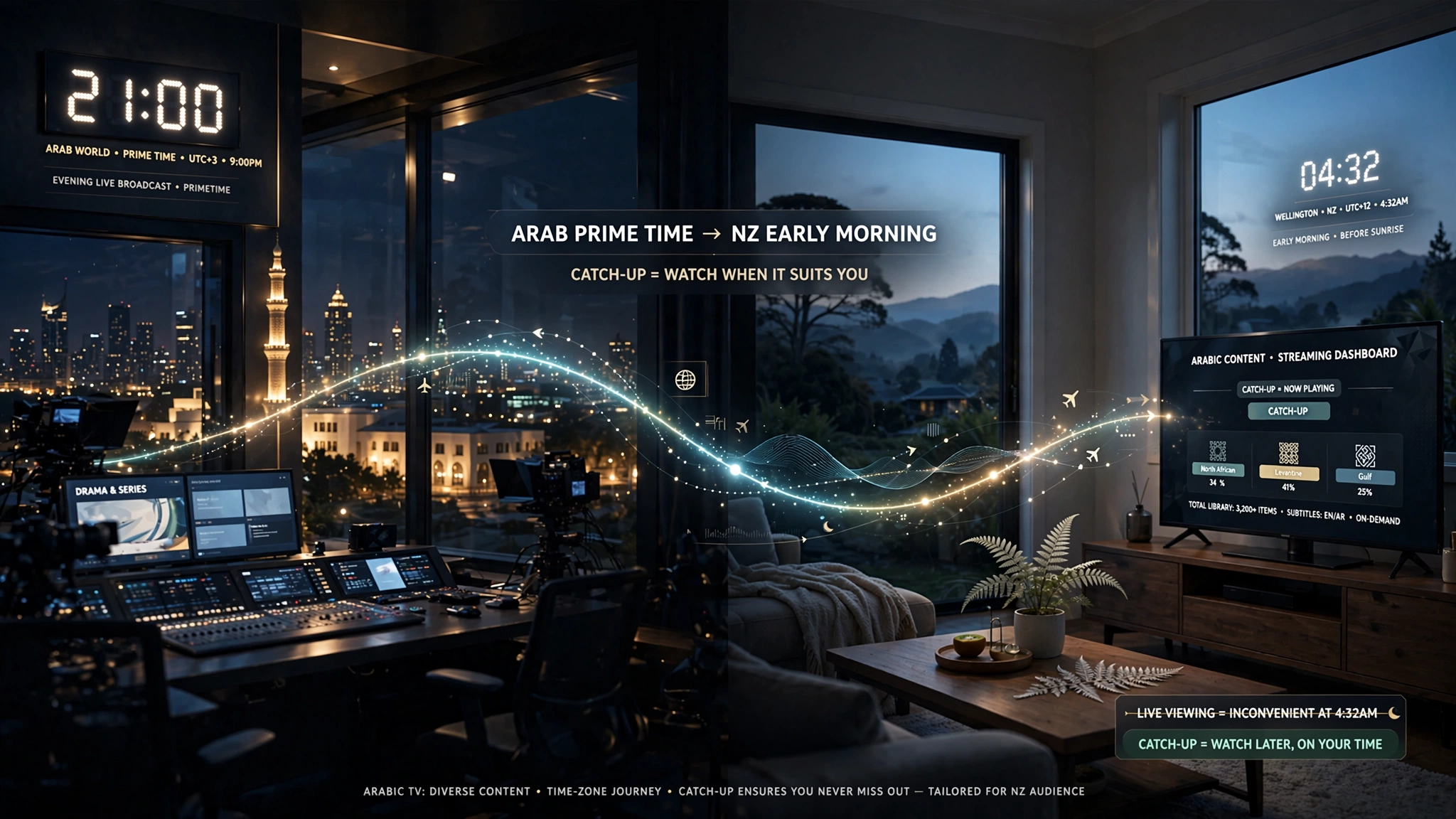
This is the most practical issue for Arabic content in New Zealand, and it is almost entirely absent from guides written elsewhere.
New Zealand sits at UTC+12. The Gulf sits at UTC+4, the Levant and Egypt around UTC+2 to +3, and Morocco around UTC+0 to +1. Prime-time evening programming across the Arab world therefore lands in New Zealand somewhere between the small hours and mid-morning.
The practical consequence: the flagship drama that airs at nine in the evening in Cairo or Dubai reaches a Christchurch living room in the early hours. For live news that may not matter. For the drama series a family watches together, it matters enormously.
Catch-up is the answer, which is why it appeared in the checks above. A service with a usable catch-up window turns an inconvenient broadcast schedule into ordinary evening viewing. A service without one leaves you choosing between an alarm clock and missing it.
The issue becomes especially pointed during Ramadan, when Arab broadcasters air their most anticipated programming of the year in evening slots. For New Zealand households, that entire season is effectively catch-up viewing. If Ramadan programming is why you are subscribing, confirm that catch-up covers it before you pay, rather than discovering the gap in the first week.
Is It Illegal to Pay for IPTV?
This is a sharper question than it first appears, and it is worth separating out.
Paying for a service does not make it licensed. IPTV is a delivery technology, not a legal category: a provider holding proper distribution rights operates legitimately, and one without them does not, regardless of whether money changed hands. The payment does not determine the position. The licensing is.
This is why the licensing question sits at the centre of this guide rather than at the end. For the full legal picture in New Zealand, see “Is IPTV Legal in NZ?”
What Should It Cost?
Prices vary widely and change often, so rather than quoting figures that go stale, here is how to think about them.
Content licensing costs money. A service that offers a vast number of international channels at a price lower than that of a single streaming subscription is describing an arrangement that does not fund licensing. That is a signal about the business model, not a bargain.
At the other end, compare any annual total; an official service may cost less and raise fewer questions for households that primarily watch one network’s drama catalogue.In the ama catalogue, an official service may well cost less and raise fewer questions. For a household drawing on several countries and categories, the arithmetic changes.
Work in annual totals rather than monthly figures, include any renewal price rise, and compare against the official route rather than against other IPTV providers. That comparison is the one that tells you something.
Common Misconceptions
“More channels means better Arabic coverage.” Channel counts say nothing about whether the specific regional content your household watches is included. A service with a smaller, better-curated Arabic offering may serve you far better than one advertising tens of thousands of channels.
“There is no legitimate way to watch Arabic TV in New Zealand.” Not true. Official streaming platforms operated by Arabic broadcasters are a real option worth checking first, and some Arabic news channels stream free through their own official channels.
“Any service with Arabic channels will have what I want.” Arabic content is regionally specific. North African, Levantine and Gulf programming are separate markets, and a service strong in one may carry very little of another.
“Paying for a service means it is licensed.” It does not. Payment and licensing are separate questions, and only the second one determines the legal position.
“A free trial proves the service is legitimate.” It proves the streams work today. Licensing status is a different question that a trial cannot answer.
Legal Note
Content availability through any IPTV service depends on the distribution rights that individual providers hold, which vary considerably and should be verified rather than assumed. Services streaming content without valid licensing are operating in breach of the Copyright Act 1994. For the full legal position, see Is IPTV Legal in NZ?
The Bottom Line
Arabic-speaking households in New Zealand are seeking alternatives because mainstream broadcasting here has never served them. That gap is real, and it is not closing on its own.
The order that makes sense: write down the categories your household actually watches; check whether official platforms operated by Arabic broadcasters cover them; and only then evaluate a broader service — asking about content categories rather than channel counts, about licensing rather than features, and about catch-up before anything else, because New Zealand’s time zone makes it the difference between watching and not.
And whatever you choose, test it on the television you will actually use, at the hour you will actually watch, before committing to a year of it.
Related NZ Streaming Guides
- International IPTV NZ Guide — the wider multicultural picture
- How to Choose an IPTV Service in NZ — the general evaluation framework
- Is IPTV Legal in NZ? — the legal position explained
- Best IPTV Devices NZ — getting content onto your television
- Kiwi IPTV Guide — complete NZ streaming overview
Sources
- MELAA population and growth, 2023 Census: Stats NZ
- NZ Copyright Act 1994: legislation.govt.nz
- Consumer rights when a service fails to match its description: consumer protection. govt.nz