
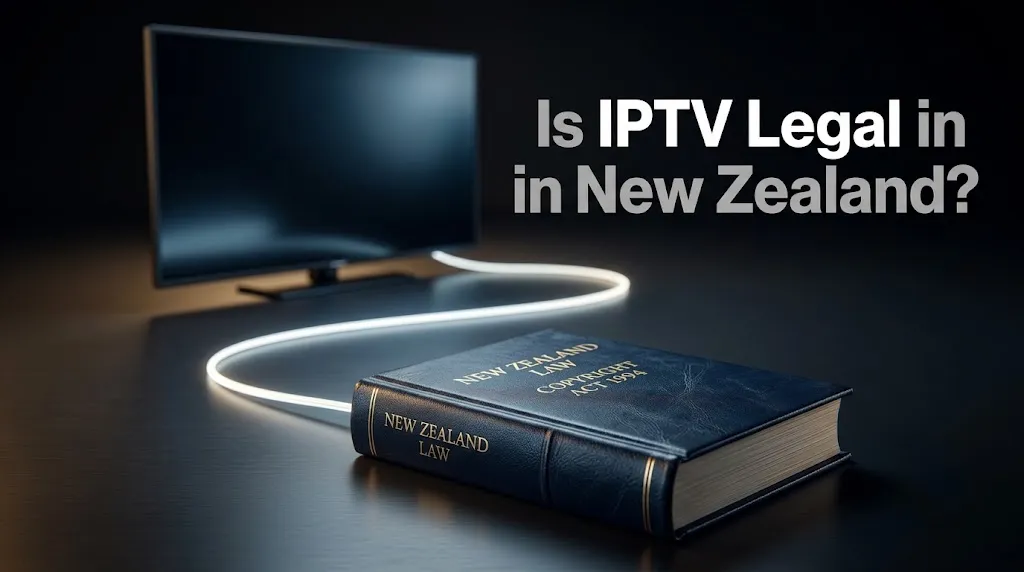
The question gets asked as though there were a single answer covering everything called IPTV, and there isn’t — which is why the internet returns such contradictory results. New Zealand law does not regulate delivery methods. It regulates whether the content being delivered is authorised.
That single distinction resolves most of the confusion, and it also explains why two services that look identical from the outside can sit on opposite sides of the line. For the wider picture of how streaming works here, the Kiwi IPTV guide covers the landscape; this article stays on the legal position.
Quick Answer
Is IPTV legal in New Zealand? The technology is. IPTV means television delivered over internet protocol, and TVNZ+, Neon, Sky Sport Now and Netflix all use it. What determines legality is whether a service holds distribution rights for what it carries, under the Copyright Act 1994.
| IPTV as a technology | Legal — it is a delivery method |
| Services holding content agreements | Legal |
| Services without content agreements | Infringing under the Copyright Act 1994 |
| Governing statute | Copyright Act 1994 |
| Where enforcement has focused | Sellers and operators, not individual viewers |
| Also relevant | Fair Trading Act 1986, for claims made about a service |
| Last reviewed | September 2026 |
Is IPTV Legal in New Zealand? The Direct Answer
Yes, with one qualification that carries all the weight: legality attaches to the service, not the technology. IPTV describes how television travels — over internet protocol rather than by satellite or aerial. Sky Sport Now is IPTV. TVNZ+ is IPTV. The law is indifferent to that. What it asks is whether the content was authorised.
Under the Copyright Act 1994, communicating a copyright work to the public is a restricted act. Doing it without the rights holder’s authorisation is an infringement, whatever the transport mechanism. A service streaming a broadcaster’s content without an agreement is infringing whether it reaches you by satellite, cable, or broadband.
That framing also explains why “is this IPTV service legal” cannot be answered by looking at the app, the device, or the picture quality. None of those carry the information. Only the licensing position does.
Key takeaway: New Zealand copyright law regulates whether content is authorised, not how it is delivered — so no delivery technology is illegal in itself.
What Does New Zealand Law Actually Say?
The Copyright Act 1994 predates IPTV and never mentions it by name, and it doesn’t need to. The restricted act it defines — communicating a copyright work to the public without the rights holder’s authorisation — is drafted broadly enough to cover delivery methods invented long after it was written, including internet streaming.
The Copyright (New Technologies) Amendment Act 2008 updated the framework for internet delivery, adding liability provisions for internet service providers and creating a notice regime for infringement through file sharing.
Why the File-Sharing Notice Regime Is Often Misunderstood
The notice regime — what most people mean when they say “three strikes” — was built around peer-to-peer file sharing, where a user’s machine both downloads and uploads parts of a file to others. Live streaming is technically different: the viewer receives, and doesn’t redistribute.
That distinction matters, and it is regularly misreported in both directions. It does not mean streaming is outside the Copyright Act, because the restricted act of unauthorised communication sits elsewhere in the statute. Nor does it mean a streaming viewer is treated exactly as a file sharer would be. They are different mechanisms with different enforcement paths. Anyone writing about the current status of that regime should check it against the legislation directly, since it has been under review at various points.
What Have New Zealand Courts Actually Decided?
Two cases are cited constantly and described inaccurately almost as often. Both were brought by Sky against sellers of pre-loaded streaming boxes, and both were decided on consumer law rather than copyright law — a detail that changes what they actually tell a New Zealand household about its own position.
In Sky Network Television Ltd v My Box NZ Ltd [2018] NZHC 2768, Sky took action against a seller of pre-loaded streaming boxes. The significant point is the route it chose: Sky brought the claim under the Fair Trading Act 1986, not as a copyright infringement action. The complaint was that the boxes had been marketed to New Zealanders as a lawful way to watch Sky’s content when they were not. The High Court found the representations misleading, and declined to grant the wider injunction sought, noting that relief of that kind would properly be sought under the Copyright Act.
A second case in the Christchurch District Court reached a similar outcome against the sellers of Fibre TV boxes, again turning on misleading representations to purchasers.
Two things follow, and both are widely missed:
First, both cases targeted sellers, not viewers. Neither proceeded against a household.
Second — and this is the part almost nobody reports — the effective legal exposure in New Zealand has come from claiming a service is legal, not merely from operating one. Proving copyright infringement piece by piece is slow and expensive; proving a misleading marketing claim is neither. That is why consumer law, rather than copyright law, has done the work here.
Key takeaway: New Zealand’s landmark streaming cases were consumer-law cases about misleading claims of legality, brought against sellers rather than viewers.
How Can You Tell If an IPTV Service Is Licensed?
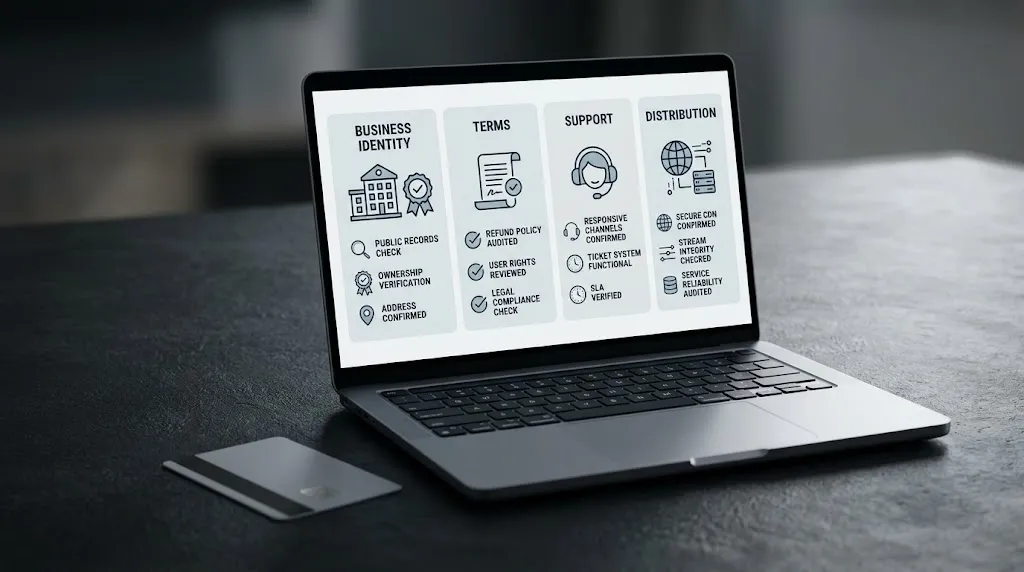
You often can’t be certain from the outside, and any guide claiming otherwise is overstating what is knowable. What you can do is check a handful of indicators that are difficult to fake — business identity, written terms, a working support channel — and treat their absence as the finding rather than as an open question.
| Indicator | What supports a licensed position | What raises questions |
|---|---|---|
| Business identity | Named company, stated jurisdiction, contact address | No company name anywhere on the site |
| Privacy policy | References the Privacy Act 2020 or an equivalent regime | Absent, or generic boilerplate naming no law |
| Pricing | Stated in NZD with written subscription terms | Unclear, or changes between pages |
| Support | A channel that answers, with a stated response time | Chat widget only, no address, no company |
| Distribution | Listed on a mainstream app store | Requires sideloading as the only route |
| Content claims | Specific about what it carries | Very large channel totals with no explanation |
The channel-count point deserves explanation rather than assertion. Content rights are sold territory by territory, and licensing thousands of channels across many territories is legally and financially substantial work. A service advertising an enormous total at a very low price is making a claim that doesn’t reconcile with how rights are actually acquired — which doesn’t prove anything by itself, but is a question worth asking before payment rather than after.
How to choose an IPTV service in NZ works through the assessment in more detail.
What Are the Practical Risks for NZ Viewers?
The realistic risks for a New Zealand household are less dramatic than the headlines suggest and more mundane than most articles admit. They are mainly commercial rather than legal: losing access without warning, having no consumer remedy afterwards, and exposing payment details to a business you cannot identify.
Losing the service without warning. When enforcement reaches an operator, the service stops. There is no notice period, no refund process, and usually nobody to contact.
No consumer remedy. The Consumer Guarantees Act 1993 gives real rights against a supplier you can identify and reach. Those rights are of limited practical use against a business whose location and legal identity are unknown. This is the difference between the two categories that actually shows up in someone’s life.
Payment exposure. Card details entered on a site with no verifiable business behind it carry a risk independent of the copyright question.
Legal exposure. Enforcement in New Zealand has been directed at operators and sellers rather than viewers. That describes where resources have gone; it is not a statement that unauthorised viewing is lawful. Those are different claims, and conflating them is how most articles on this subject go wrong.
Does a VPN Change the Legal Position?
No. A VPN changes what your internet provider can observe about your connection, and nothing else that matters here. It does not alter whether the content you are watching was authorised by its rights holder, and it does not change how the Copyright Act 1994 applies to that content or to you.
This site does not recommend using a VPN to reach content that is geo-restricted. Geo-restriction exists because rights are sold by territory, so working around it is working around the licensing arrangement itself — which is the thing the law is concerned with. The VPN and IPTV in NZ guide covers what a VPN does and doesn’t do.
Common Misconceptions
“All IPTV is illegal.” No. TVNZ+, Neon, Sky Sport Now and Netflix are all IPTV by technical definition. The delivery method is neutral.
“New Zealand doesn’t enforce this.” Sky has pursued sellers through NZ courts successfully. Enforcement has been narrower than in some countries, and directed at operators — that is a description of priority, not permission.
“A big channel count means it must be licensed.” If anything the reverse. Large totals at low prices are harder to reconcile with how rights are bought, not easier.
“My internet provider will warn me.” The notice regime covers file sharing specifically. Live streaming sits under different provisions, and viewers should not expect a warning system to function as a safety net.
“The device makes it illegal.” A streaming box or stick is general-purpose hardware. What was loaded onto it, and where that content came from, is the question — which is what the My Box case turned on.
Official and Licensed Options in New Zealand
Before assessing anything else, it’s worth knowing what is unambiguously available. TVNZ+ and ThreeNow are free and carry New Zealand free-to-air content. MĀORI+ is free. Sky Sport Now, Neon, Netflix, Disney+ and Prime Video are subscription services operating here with content agreements in place.
For most households, a combination of those covers more than expected. Where they genuinely don’t reach — international channels, other languages — the international IPTV NZ guide covers what exists, and the NZ sports IPTV guide covers the sports rights picture.
This article is for educational and comparison purposes only. Verify the licensing status of any streaming service and ensure compliance with New Zealand copyright law before subscribing. It does not constitute legal advice.
Explore More
Guides: Kiwi IPTV Guide · IPTV vs Sky NZ · How to Choose an IPTV Service NZ
Clusters: NZ Sports IPTV Guide · International IPTV NZ Guide
Setup: IPTV Setup Guide NZ · Best IPTV Devices NZ · VPN and IPTV NZ
Bottom Line
Is IPTV legal in New Zealand? The answer splits three ways depending on where you stand:
If you’re deciding whether to use IPTV at all — the technology raises no legal question. Start with the licensed services operating here and see how far they actually get you before looking further.
If you’re assessing a specific service — the question is licensing, and the practical test is whether a real business identity, written terms, and a reachable support channel exist. If those can’t be established before payment, that is the finding.
If you’re weighing the risk of a service you already use — the realistic exposure for a household is losing access with no refund and no recourse, rather than legal action. Enforcement here has gone after sellers, and particularly after those claiming their product was legal when it wasn’t.
Sources
- Copyright Act 1994 — legislation.govt.nz
- Consumer Guarantees Act 1993 — consumerprotection.govt.nz
- Privacy Act 2020 — privacy.org.nz