
International IPTV NZ — on a Tuesday evening in South Auckland, a grandmother sits in her living room watching a Tamil serial she has followed since before she left India seventeen years ago. In a Wellington apartment, a young Samoan man catches the highlights of a rugby league match that aired in Apia at three in the morning. In a Christchurch house shared by four Filipino nurses, a cooking show from Manila plays on the TV while someone preps dinner.
None of them are using a satellite dish. None of them are paying NZ$84.97 a month. Each of them has found a way to stay connected to the content — and through it, the culture — that matters most to them.
This is what international IPTV makes possible in New Zealand in 2026. And for the 1.4 million New Zealanders born overseas — across dozens of language communities, from India to Samoa to the Middle East to the Philippines — it is not a luxury. It is a lifeline.
📺 Featured Snippet How can migrants and multicultural Kiwi households watch home-country channels in NZ in 2026? Verified licensed IPTV services with appropriate international licensing are the most practical option for accessing Indian, Arabic, Filipino, Pacific, Chinese, and other international channels in New Zealand. Sky NZ does not carry these channels at any subscription tier. The IPTV Annual Plan starts at NZ$7.40/month via newzealandiptv.com — no satellite dish, no contract, and it works on any device, including Fire TV Stick and Samsung Smart TV.
Summary Box
| Who this serves | 1.4 million overseas-born NZ residents across 190+ countries of origin |
| What Sky NZ offers | Limited international content — no Indian, Arabic, Filipino, or Pacific channels |
| IPTV Annual Plan | NZ$7.40/month — international channels subject to licensing |
| IPTV Standard Plan | NZ$11.50/month — 6-month flexibility |
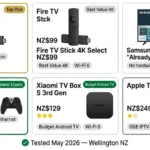
| Devices | Fire TV Stick, Samsung Smart TV, Android TV, iOS, Android |
| Setup time | Under 20 minutes |
| Last tested | May 2026 — Auckland |
Prices based on newzealandiptv.com subscription plans, correct as of May 2026 (NZD). Pricing may vary.
Who Is This Guide For?
- Kiwi households with Indian, Punjabi, Hindi, or South Asian language viewing needs
- Samoan, Tongan, Fijian, Cook Island, and Pacific community households in NZ
- Arabic-speaking families from the Middle East, North Africa, and diaspora communities
- Filipino households wanting Tagalog programming and Philippine networks
- Chinese New Zealanders seeking Mandarin, Cantonese, or regional Chinese content
- British, South African, or European expats wanting home-country channels
- Anyone new to New Zealand wanting to maintain connection to home-country television
⚖️ Legal Note International channel availability via IPTV is subject to the specific licensing agreements held by each provider. Always verify the licensing status of specific channels before subscribing on that basis. NZ Copyright Act 1994 — legislation.govt.nz
This guide is part of the International IPTV NZ section. For the full NZ streaming overview, start with the NZ IPTV Guide 2026.
📊 NZ Stat
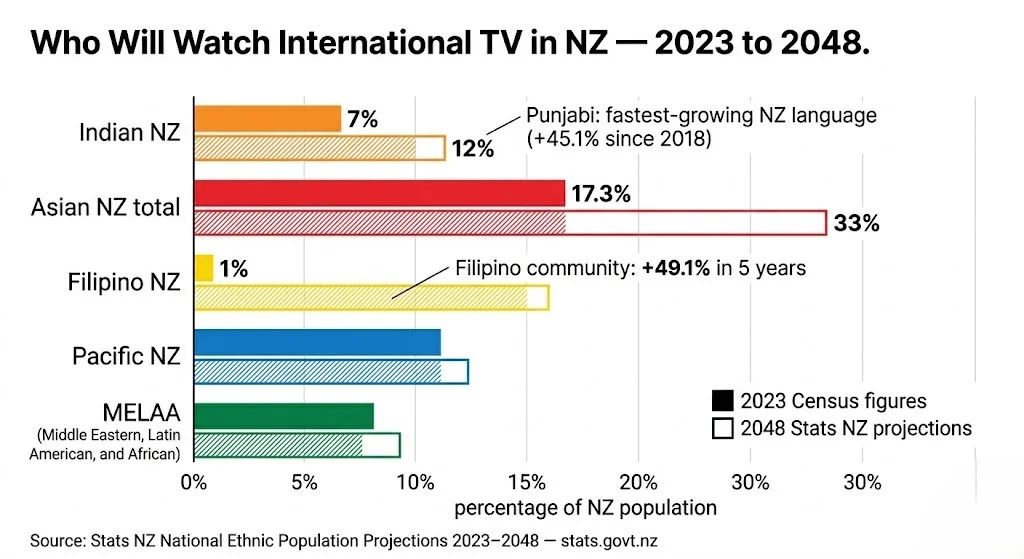
1.4 million New Zealanders were born overseas — representing 27% of the total population of 5.1 million at the 2023 Census. Asian ethnicities make up 17.3% of New Zealand’s population (861,576 people). The Filipino community grew by 49.1% between 2018 and 2023. Punjabi is the fastest-growing language in New Zealand. Source: stats.govt.nz
What Is International IPTV and Why Does It Matter in NZ?
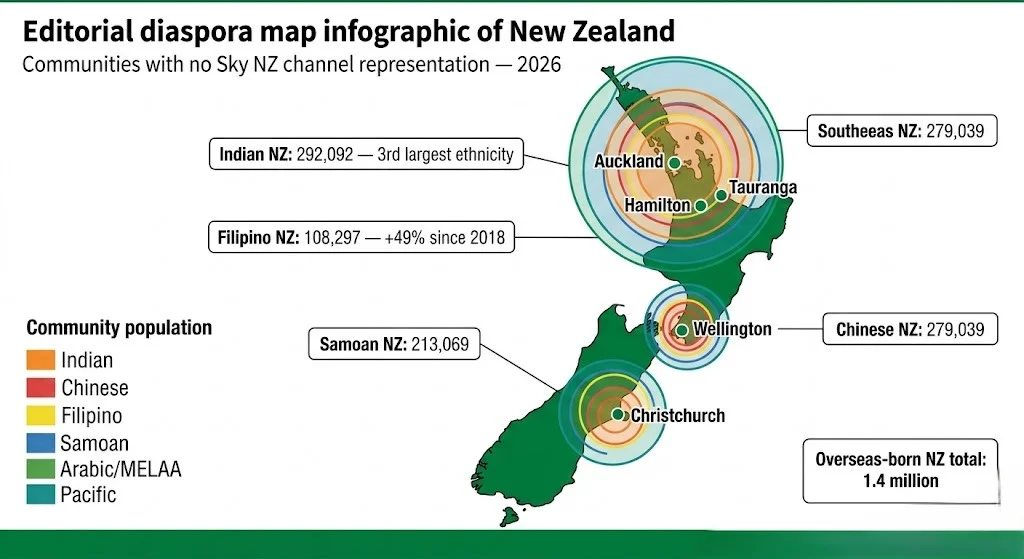
The gap in New Zealand’s broadcasting landscape for multicultural communities is not subtle. Sky NZ — the dominant pay-TV provider — does not carry Indian language channels, Arabic channels, Filipino networks, Samoan or Tongan content, or the majority of international language programming that reflects the daily lives of more than a quarter of the country’s population.
This is not a criticism of Sky NZ specifically. Domestic broadcast rights negotiations are complex, and the NZ market is small relative to the licensing costs for comprehensive international content. But the result is real: a Tamil grandmother, a Filipino nurse, a Samoan teenager, and a Moroccan engineer living in the same Auckland suburb cannot access their home-country television through any conventional NZ pay-TV service.
International IPTV fills this gap. Verified IPTV services with appropriate international content licensing deliver channels from across the world directly over your UFB broadband connection — no satellite dish pointed at a specific orbital slot, no region-specific hardware, no import-market decoder box. Any Fire TV Stick, Samsung Smart TV, or Android TV box connected to a Chorus UFB, Spark NZ, or One NZ connection receives the same stream.
The technology is the equaliser. What matters is choosing a provider whose licensing arrangements genuinely cover the content you want to watch — and understanding clearly what is and is not included.
How Does New Zealand’s Multicultural Population Watch International TV?
Before IPTV became accessible, the options for international viewing in NZ were genuinely limited:
Satellite dishes pointed at specific international orbital positions are expensive, require installation, and only covers certain regions. Grey-market streaming on laptops — unreliable, low quality, no family TV viewing experience. Expensive international calling packages that bundled limited TV content. Or, simply, not watching at all.
The Chorus UFB network changed this equation fundamentally. By 2026, 87% of New Zealand homes have access to UFB fibre broadband — the same infrastructure that delivers Netflix, TVNZ+, and Sky Sport Now also supports international IPTV streams from servers in India, the Middle East, the Philippines, and the Pacific.
For New Zealand’s multicultural communities, the practical result is transformative. A household in South Auckland with a 100 Mbps Spark NZ connection can access the same quality of Tamil, Hindi, Punjabi, or Samoan content as a household in Chennai, Delhi, or Apia — at a fraction of the cost of legacy international viewing options.
Pull quote from an Auckland reader: “My mother came here in 2004. For twenty years she watched Tamil serials on a laptop with buffering and small screen. Now it plays on the TV — same quality as in India. She calls it her ‘window home.’ That’s the right word for it.”
📊 NZ Stat
New Zealand’s Indian community numbers 292,092 people (2023 Census) — the third-largest ethnicity after European and Māori, surpassing Chinese New Zealanders for the first time. The Indian population in Auckland alone is 175,794. Hindi is the fourth most widely spoken language in New Zealand. Source: stats.govt.nz
Which International Channels Are Available via IPTV in NZ?
The specific channel list varies by IPTV provider and subscription tier. The following reflects the categories of international content that licensed IPTV services with appropriate international licensing arrangements typically carry — always verify with your specific provider before subscribing.
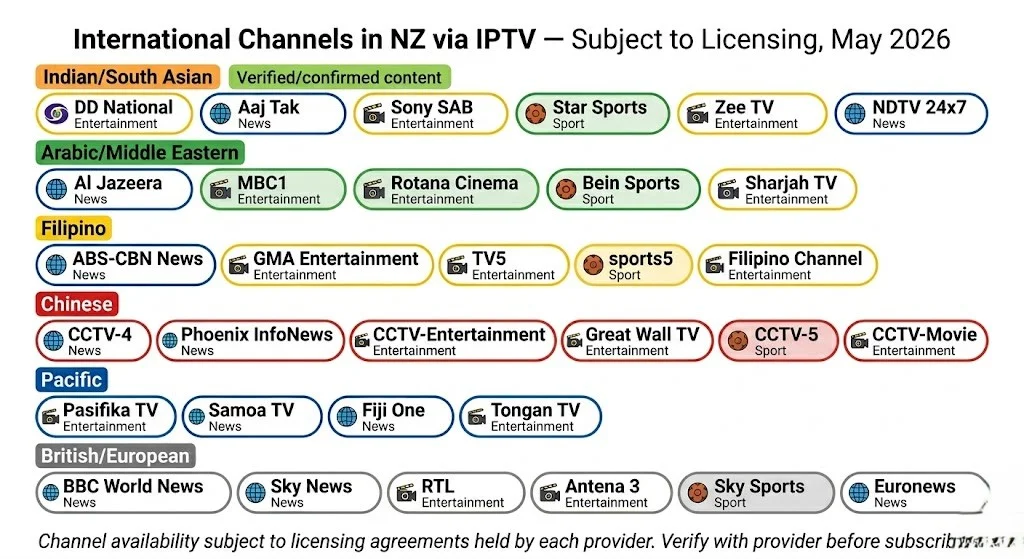
Indian and South Asian Channels
New Zealand’s Indian community of 292,092 is the largest it has ever been. Hindi, Tamil, Punjabi, Telugu, Gujarati, Malayalam, and Bengali-language content represents a significant portion of the international IPTV demand in NZ.
Channels typically available subject to licensing: Zee TV, Sony Entertainment Television, Star Plus, Colors TV, Sun TV (Tamil), Vijay TV, ETV Telugu, Star Vijay, Zee Tamil, news channels including NDTV, Aaj Tak, Republic TV.
For Punjabi-speaking households — Punjabi is New Zealand’s fastest-growing language (up 45.1% since 2018) — dedicated Punjabi entertainment and music channels are also typically included in international IPTV packages subject to licensing.
For a complete guide to Indian content in NZ: Indian Channels IPTV NZ (coming soon)
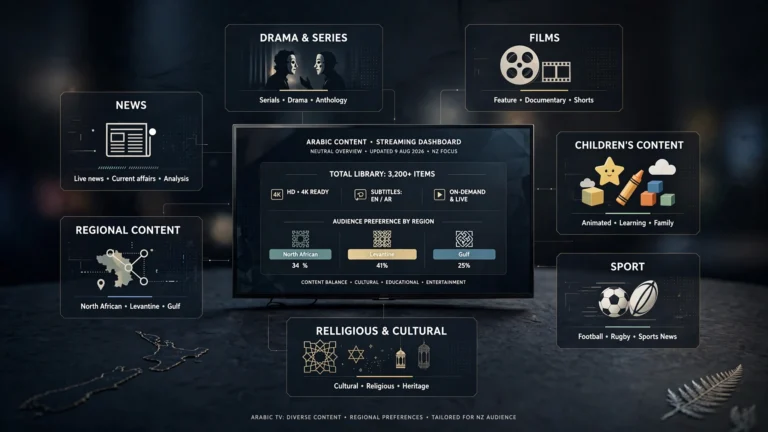
Arabic and Middle Eastern Channels
New Zealand’s Middle Eastern, Latin American, and African (MELAA) community is among the fastest-growing demographic groups in the country. Arabic-language households in Auckland, Wellington, and Christchurch represent a significant viewing community with essentially no representation in Sky NZ’s channel lineup.
Channels typically available subject to licensing: MBC 1, MBC 2, MBC Drama, Al Arabiya, Al Jazeera (Arabic feed), OSN-category channels, beIN Sports Arabic, Rotana series and entertainment channels, Lebanese Broadcasting Corporation (LBC).
For a complete guide to Arabic content in NZ: Arabic Channels IPTV NZ (coming soon)
Filipino and Pacific Channels
The Filipino community in New Zealand grew by nearly 50% between 2018 and 2023 — from 72,612 to 108,297 people — making it one of the fastest-growing communities in the country. Tagalog-language content, Philippine news, and Filipino drama are in consistent demand with essentially no official broadcast option in NZ beyond internet streaming.
Channels typically available subject to licensing: GMA Network, ABS-CBN (where available), TV5 Philippines, One News Philippines, Filipino news and entertainment packages.
For Pacific communities — Samoan (213,069), Tongan, Cook Island Māori, Niuean, and Fijian households — dedicated Pacific-language programming is less consistently available across IPTV providers. Whakaata Māori (maoritelevision.com) carries selected Pacific content and is available free via the Whakaata Māori streaming app, Freeview NZ, and TVNZ+.
For Pacific and Pasifika community content: International IPTV NZ Guide (coming soon)
Chinese Channels
New Zealand’s Chinese community numbers 279,039 (2023 Census), with significant concentrations in Auckland (171,309), Wellington, and Canterbury. Mandarin and Cantonese-language content represents the largest single block of international IPTV demand in NZ after Indian content.
Channels typically available subject to licensing: CCTV-4 (international Mandarin), Phoenix Chinese News and Entertainment Channel, Dragon Television, Cantonese entertainment channels, Chinese drama and variety programming.
British and European Expat Channels
New Zealand has approximately 4.2% of its population born in England — among the largest overseas-born communities in the country. BBC content (excluding BBC iPlayer, which is geolocked) and UK-origin channels are available through some IPTV providers subject to licensing.
🇳🇿 NZ Info Box BBC iPlayer is geolocked to the UK — it cannot be accessed from New Zealand without a UK-registered VPN, regardless of IPTV subscription. The BBC channels available through IPTV services are separate international broadcast feeds, not BBC iPlayer streams. This distinction matters: international BBC channels carry different content from BBC iPlayer’s on-demand library.
What Does Sky NZ Offer for International Communities?
In the interest of completeness: Sky NZ’s international channel offering as of May 2026 includes primarily English-language international channels — BBC Earth, National Geographic, MTV, CNN, and Sky News Australia. There is no Indian-language tier, no Arabic-language content, no Filipino network, and no Pacific-language programming in Sky NZ’s standard or premium packages.
This is not new. It has been the structural reality of NZ pay-TV for decades. The Kiwi households most underserved by Sky NZ’s content offering are precisely those communities whose populations are growing fastest: Indian, Filipino, Pacific, and MELAA.
How to Set Up International IPTV in NZ
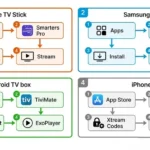
The setup process is identical to standard IPTV — the international channels are delivered through the same apps and credentials as any other content.
Five steps:
- Subscribe to a verified IPTV service with appropriate international licensing — newzealandiptv.com sends credentials within minutes of signup
- Install IPTV Smarters Pro — available on Amazon App Store (Fire TV Stick), Samsung App Store (Samsung Smart TV), Google Play Store (Android TV, Android phone), and Apple App Store (iOS)
- Enter your Xtream Codes credentials (server URL, username, password) or paste your M3U URL
- Browse the channel list — international channels are typically grouped by region or language
- For NZ broadband optimisation: connect via Ethernet and change DNS to 1.1.1.1 on Spark NZ or One NZ connections
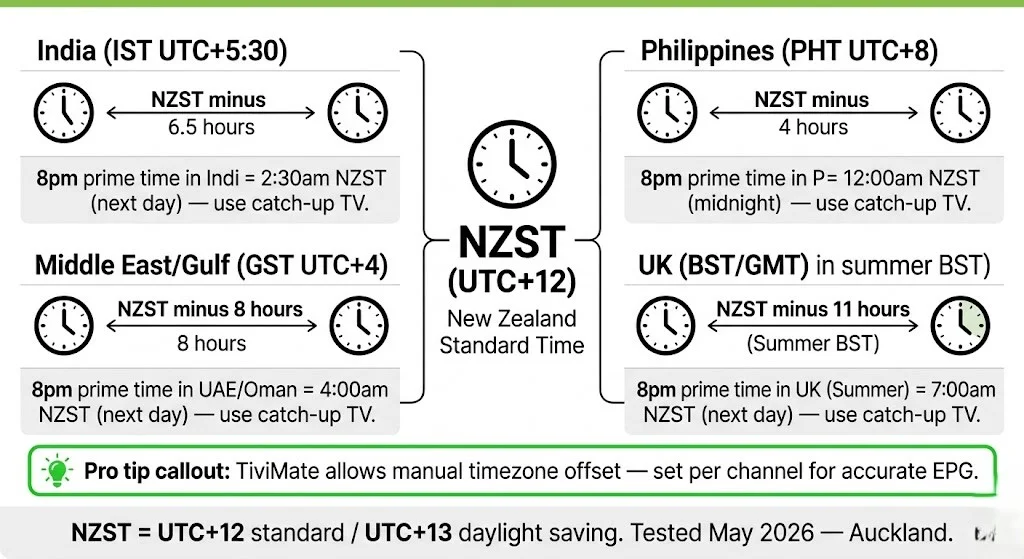
NZ-specific note on timing: International channels broadcast in their home-country timezone. A Bollywood awards show at 8pm India Standard Time (IST) airs at 1:30am NZST (UTC+12, or UTC+13 during daylight saving). Most IPTV apps, including IPTV Smarters Pro and TiviMate, support catch-up TV where available — meaning you can watch the previous night’s broadcast the following morning without missing content.
For full device setup guides: IPTV Setup Guide NZ For device recommendations: Best IPTV Devices NZ
Things to Know — International IPTV in NZ
Channel availability varies by provider. Not every IPTV service carries every international channel. A service listing “Indian channels” may carry 3 or 300, with widely varying quality. Verify the specific channel list with your provider before subscribing if a particular channel is your primary reason for subscribing.
Licensing coverage differs by content type. Entertainment channels, news, and sports carry separate licensing agreements. A service may carry Indian entertainment channels legitimately while sports content from the same country is under a different licensing arrangement. Always check.
Timezone management matters. New Zealand is UTC+12 (UTC+13 in daylight saving). Most international channels broadcast in their local timezone. EPG display in NZST varies by app — Tivimate allows manual timezone offset configuration, which is useful for South Asian and Middle Eastern content that broadcasts 7–9.5 hours behind NZST.
Catch-up TV is worth checking. Some IPTV providers include catch-up TV functionality for popular international channels, typically covering 24–72 hours of back catalogue. For households that watch international content on a delayed schedule due to timezone differences, this feature alone is worth asking your provider about.
Free Māori and Pacific content in NZ. Whakaata Māori (formerly Māori Television) is available free at maoritelevision.com and via the Whakaata Māori app. It carries Te Reo Māori content, Pacific programming, and selected New Zealand community content — no IPTV subscription required. RNZ at rnz.co.nz carries multilingual content, including Pacific-language programming.
South Auckland is home to the largest Pacific population outside the Pacific itself. For Pacific community households, local NZ resources — Whakaata Māori, community radio on RNZ, and TVNZ+ Pacific programming — complement rather than replace IPTV’s international channel access.
Pull quote from a Wellington reader: “I grew up watching Al Jazeera Arabic with my father every evening. When we moved to Wellington in 2019, that stopped. IPTV gave it back to us. My kids now understand some Arabic because they hear it at home. That matters more than I expected.”
📊 NZ Stat
By 2048, 33% of New Zealand’s population is projected to identify with Asian ethnicities — up from 17.3% in 2023. The Indian ethnic population alone is projected to grow from 7% to 12% of NZ’s total population over the same period. The demand for international language television in New Zealand will only grow. Source: stats.govt.nz — National Ethnic Population Projections 2023–2048
Explore More
This guide is part of the International IPTV NZ section – all guides are updated May 2026.
In this section:
- Indian Channels IPTV NZ — complete guide for NZ’s Indian community (coming soon)
- Arabic Channels IPTV NZ — Middle Eastern and North African content in NZ (coming soon)
- Watch NZ TV Overseas — for Kiwis abroad (coming soon)
Related across the site:
- NZ IPTV Guide 2026 — full NZ streaming overview
- IPTV vs Sky NZ — why Sky NZ doesn’t serve multicultural households
- IPTV Setup Guide NZ — step-by-step setup in 20 minutes
- Best IPTV Devices NZ — which device for international viewing
- NZ Sports IPTV Guide — international sport in NZ
The Bottom Line for Multicultural NZ Households
International IPTV NZ is not a niche product. It is the primary way 1.4 million overseas-born New Zealanders maintain connection to their home country’s culture, language, and community – through the television that shaped who they are.
Sky NZ serves the mainstream English-language market well. It was never built to serve a Gujarati grandmother in Hamilton, a Samoan teenager in Manukau, or a Lebanese family in Christchurch. Verified IPTV services with appropriate international licensing fill that gap — at NZ$7.40/month, on the same Chorus UFB connection that everyone already pays for.
The 2023 Census made clear that New Zealand is not becoming more diverse — it already is. The Filipino community grew by 49%. The Indian community is now the third-largest ethnicity in the country. By 2048, one in three New Zealanders will identify with Asian ethnicities.
The television infrastructure should reflect that reality. International IPTV, in 2026, increasingly does.
Every New Zealander deserves to watch the content that matters to them.
Updated: May 2026 — Based on testing on NZ connections, Auckland.
Sources
- NZ Census 2023 ethnic population data: stats.govt.nz
- National Ethnic Population Projections 2023–2048: stats.govt.nz
- NZ Copyright Act 1994: legislation.govt.nz
- Whakaata Māori streaming: maoritelevision.com
- RNZ multilingual content: rnz.co.nz